Share the post "What Are Stringers on a Boat? A Simple Guide"
Key Takeaways
- Stringers are long structural beams that run from bow to stern along the inside of the hull.
- They stiffen the hull and support the floor, the engine and other heavy gear.
- Stringers are made of wood, fibreglass, foam-core composite or aluminium.
- Soft floors, cracks and a hull that flexes can signal damaged stringers.
- Sailboat stringers are often part of a moulded fibreglass grid bonded to the hull.
What are stringers on a boat? They are the hidden beams that give a hull its strength. You never see them from the deck. Yet they carry the engine, the floor and the force of every wave. In this guide, we explain what stringers do and what they are made of. We also show how sailboat stringers differ and how to spot trouble early.
What are stringers on a boat?
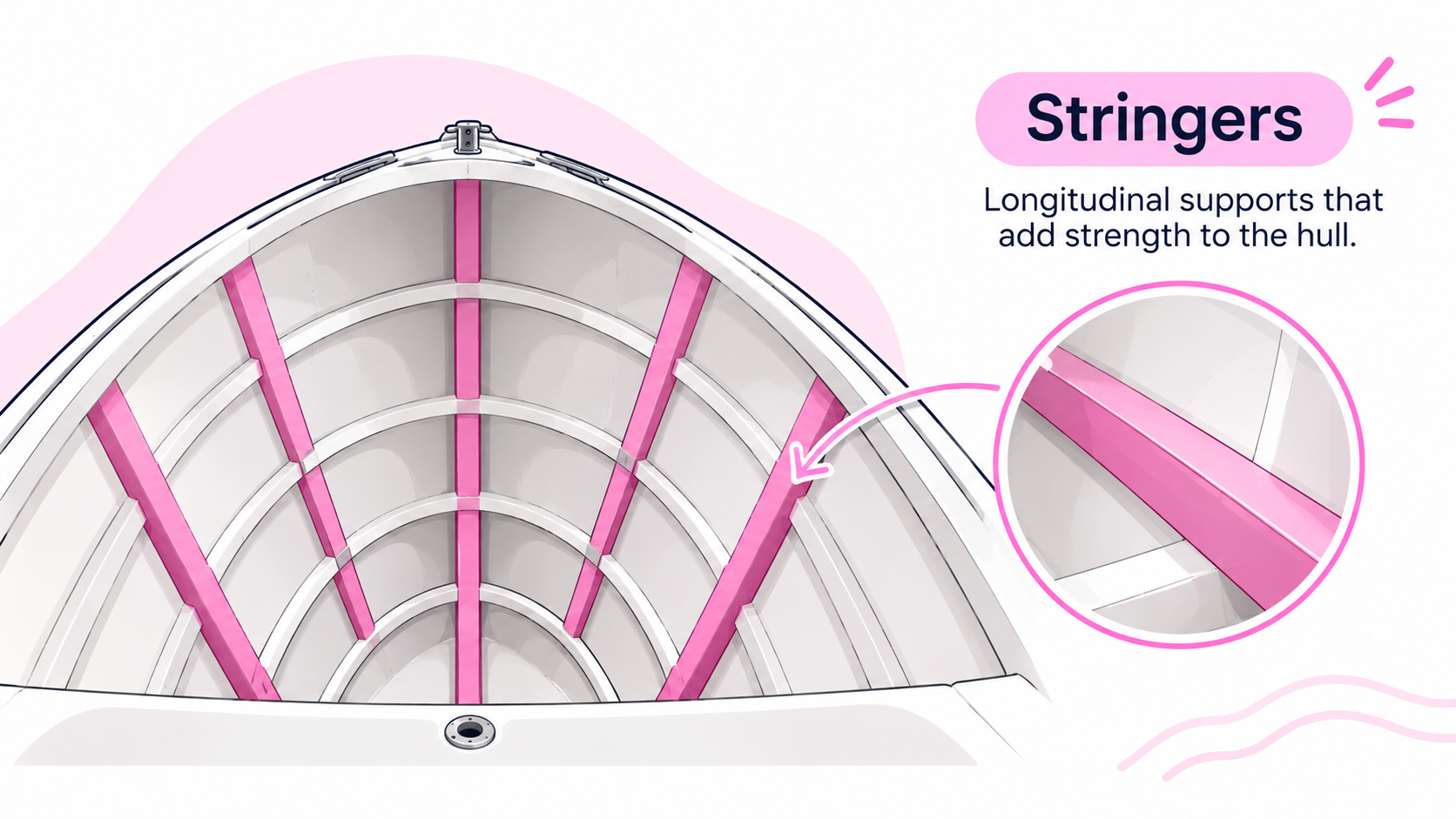
Stringers are structural parts that run lengthwise inside the hull. They start near the bow and end near the stern. Most boats have two or more, set on either side of the centreline.
Stringers do not work alone. They cross other parts, such as frames and bulkheads, which run from side to side. Together, these pieces form a rigid skeleton. The hull skin is then bonded to that skeleton.
What do stringers do?
They stiffen the hull
A thin hull would flex with every wave. Stringers spread the load along the whole length of the boat. This keeps the hull rigid and helps it hold its shape for years.
They carry the engine and the floor
On many motorboats, the engine sits on beds that are built from stringers. The cockpit floor and the deck also rest on them. Without this support, the floor would feel soft and the engine would vibrate.
They spread impact loads
A boat that slams into a wave takes a hard hit. Stringers pass that force into the rest of the structure. This protects the hull from cracks and from local damage.
Stringers vs. frames and bulkheads
Many people mix up these three parts. The main difference is their direction.
| Part | Direction | Main job |
|---|---|---|
| Stringer | Lengthwise, bow to stern | Stiffens the hull and supports the floor and engine |
| Frame (rib) | Side to side | Shapes the hull and resists sideways forces |
| Bulkhead | Side to side, as a wall | Divides the boat and adds strength |
What are boat stringers made of?
Wood
Older boats often use marine plywood or solid lumber. It is strong and easy to shape. The wood is usually covered in fibreglass. If water gets in, the wood can rot over time.
Fibreglass and foam
Many modern boats use a foam core wrapped in fibreglass. This design does not rot like bare wood. Still, damaged glass can let the foam soak up water.
Aluminium
Aluminium boats have welded aluminium stringers. They are light and strong. They need protection from corrosion, especially in salt water.
Moulded composite grids
Many production boats use a one-piece grid, moulded in fibreglass. The builder bonds it to the hull in one step. This method is fast, precise and very rigid.
Sailboat stringers: what is different?
Sailboat stringers follow the same idea as those on a motorboat. They still stiffen the hull and support the floor. But sailboats face other loads. The keel and the rigging push hard on the structure.
Most fibreglass sailboats use a moulded structural grid. It spreads the keel loads across a large part of the hull. Bulkheads help carry the loads from the rigging. After a grounding, check this area first.
Sailboats carry less engine weight than many powerboats. So their stringers are often lower and simpler. They still matter just as much for safety.
If you plan to hire a sailboat, these loads explain why a sound hull matters.
Signs of damaged stringers
Stringer damage can stay hidden for a long time. Watch for these warning signs:
- A soft or spongy spot in the floor or the cockpit
- A hull or floor that flexes underfoot
- Cracks in the fibreglass near the engine or the keel
- Extra engine vibration or noise
- A musty smell or water that keeps returning to the bilge
You can also test the structure. Tap the area with a small plastic mallet. Solid material gives a sharp ring. Rotten material gives a dull thud. For a firm answer, ask a marine surveyor.
How to protect your stringers
Water is the main enemy. Keep the bilge dry and fix leaks quickly. Check the seals around hatches, deck fittings and through-hulls. Let the boat ventilate so moisture does not build up.
Inspect the structure after a grounding or a hard impact. Small damage can often be patched. Serious rot needs a professional repair. Replacing stringers is a big job, so early action saves time and money.
Why stringers matter when you hire a boat
When you hire a boat, you do not inspect the structure yourself. The owner handles maintenance. Still, a few small checks help. Walk on the floor and listen for odd creaks. Tell the owner about any soft spot or new noise.
Knowing what stringers are also helps you choose well. Ask about the age and the condition of the boat. A well-kept hull means a calm, safe day on the water.
Planning a trip? Browse a boat hire and message the owner with your questions.
FAQ
What are stringers on a boat?
Stringers are long beams that run from bow to stern inside the hull. They stiffen the hull and support the floor, the engine and other heavy parts.
What are boat stringers made of?
Common materials are marine plywood, fibreglass over foam, aluminium and moulded composite. Many are wood or foam covered in fibreglass.
What is the difference between stringers and frames?
Stringers run lengthwise, from bow to stern. Frames, also called ribs, run from side to side. They work together to form the hull skeleton.
Do sailboats have stringers?
Yes. Many sailboats have a moulded structural grid that acts as stringers. It spreads the loads from the keel and supports the floor.
How do you know if boat stringers are rotten?
Look for soft or spongy floors, a hull that flexes and cracks near the engine or keel. A dull sound when you tap the floor is another sign.
Can boat stringers be repaired?
Small damage can often be patched with fibreglass. Rotten or broken stringers usually need a professional. In serious cases, they must be replaced.