Share the post "Europe’s best beaches to explore by boat this summer"
For many travellers, a beach holiday isn’t just about finding the sunniest destination. More and more holidaymakers are choosing locations that offer the least crowded beaches with plenty of room to relax.
That’s because when it comes to beach holiday planning, space matters. A busy beach can affect the entire experience, from where you sit to whether you stay for sunset or decide to escape elsewhere. That’s why for couples, families and travellers looking for slower-paced coastal breaks, quieter stretches of shoreline are becoming just as important as weather and scenery.
To uncover Europe’s best beach experiences, Click&Boat analysed 55 popular destinations using a combination of beach area, TripAdvisor reviews mentioning “busy” or “crowded”, weather conditions, Google review ratings and nearby airport passenger numbers as an indicator of tourism pressure. Each beach received a total score out of 100 to identify destinations most likely to feel enjoyable and spacious during peak summer.
And while choosing the right beach is important, how you experience it can make just as much difference. Hiring a boat allows you to enjoy Europe’s most spectacular coastlines from a completely different perspective, approaching beaches from the water, swimming nearby and discovering secluded coves beyond the main shoreline.
Rather than competing for space on the sand, a boat provides a private base from which to explore the coast whilst still enjoying the scenery, atmosphere, and crystal-clear waters that make these destinations so popular.
The best beaches in Europe to explore by boat
The best beaches aren’t necessarily the most remote. Instead, they combine strong visitor ratings with lower mentions of overcrowding and enough physical space to spread people out. Here they are, each with their total score out of 100.

1. Fig Tree Bay, Cyprus: 71.68
Taking the highest overall score in the index, Fig Tree Bay delivers one of the strongest combinations of popularity and available space. The beach holds an average Google rating of 4.7 from more than 1,500 reviews, yet only a relatively small proportion of TripAdvisor reviews referenced busy or crowded conditions.
With approximately 20,000m² of beach area, average summer temperatures of 26.5°C and more than 12 hours of sunshine per day, Fig Tree Bay proves that highly visited beaches can still feel spacious when supported by the right conditions.
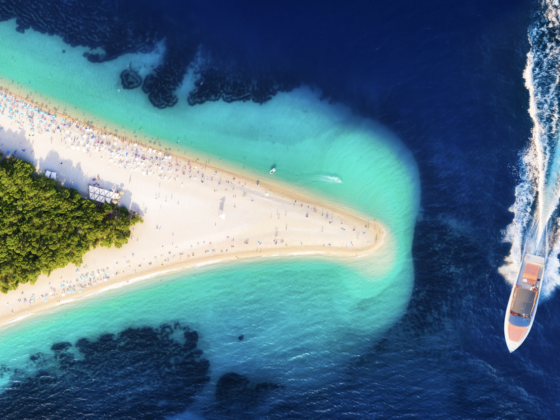
2. Zlatni Rat Beach, Croatia: 66.46
Croatia’s highest-ranking beach combines strong visitor sentiment with comparatively lower crowding indicators. Zlatni Rat receives an average Google rating of 4.4 whilst benefiting from warm summer temperatures (23°C) and long daylight hours (12.9).
Despite Croatia’s popularity as a summer destination, the beach’s generous layout and lower proportion of crowding mentions help it to secure second place.
3. Playa Burriana, Spain: 65.14
Ranking third overall, Playa Burriana stands out thanks to its balance of visitor demand and available space. With approximately 32,000m² of beach area, it offers considerably more room than many comparable Mediterranean coastlines.
Combined with strong Google review performance (4.5) and relatively limited references to overcrowding (9.9%), the data suggests that Burriana Beach remains one of Spain’s strongest options for travellers wanting atmosphere without excessive density.
4. Nissi Beach, Cyprus: 64.09
Nissi Beach in Ayia Napa performs particularly well thanks to strong review scores (4.5) and lower crowding references (13.1%) than might be expected for one of the region’s best-known beaches.
Favourable summer weather (28°C) alongside consistent sunshine (12.4 hours) help to secure its position.
5. Bačvice Beach, Croatia: 63.22
Split’s famous city beach achieves a surprisingly strong result despite serving one of Croatia’s busiest tourism hubs.
Bačvice combines strong visitor ratings (4 out of 5) with fewer mentions of crowding (21.8%) than many similarly popular destinations. The result suggests that accessibility and popularity don’t automatically reduce beach comfort when space is managed effectively.
6. Plaža Sveti Jakov, Croatia: 62.02
Croatia’s third appearance in the top six reinforces how consistently well the country performs in the rankings. Plaža Sveti Jakov benefits from strong review performance (4.5) and lower perceived crowding (17.8%) whilst maintaining favourable summer temperatures (23.3°C).
Compared with beaches facing heavier tourism pressure, it delivers a noticeably stronger balance of visitor experience and available space.
7. Mellieħa Bay, Malta: 61.71
Malta’s highest-ranked beach achieves one of the strongest scores among island destinations.
Mellieħa Bay combines substantial beach space (40,000m²) with consistently positive visitor reviews (4.5), helping to offset the effects of peak-season tourism. Its result shows that smaller countries don’t necessarily mean more crowded beach experiences.
8. Platja de Muro, Spain: 59.11
One of the clearest examples of beach size influencing the visitor experience, Platja de Muro has an approximate beach area of 240,000m², making it one of the largest beaches in the entire study.
This scale gives visitors significantly more room to spread out, helping to maintain a more relaxed atmosphere alongside strong visitor demand and consistently high review scores (4.7).
9. Ölüdeniz Plajı, Türkiye: 58.26
One of Türkiye’s most recognisable coastal destinations still performs strongly overall.
Ölüdeniz combines high visitor ratings (4.4) with great summer weather conditions (25.1°C) and lower crowding mentions (8.4%) than some comparable Mediterranean hotspots.
Its result suggests that travellers don’t necessarily need to sacrifice scenery in order to find more space.
10. Fornillo Beach, Italy: 56.88
Completing the top ten, Fornillo Beach delivers a strong balance between visitor satisfaction and lower crowding indicators.
Supported by warm summer temperatures (23°C) and positive review performance (4.4 out of 5), it outperforms many more heavily trafficked Italian beach destinations despite attracting fewer visitors overall.
Summer beach trends across Europe
Beyond the individual rankings, our data highlights which parts of Europe are creating conditions for travellers seeking more space by the coast.
Greece’s larger beaches help to reduce crowd density
Greek destinations generally performed well where beach size was strongest.
Myrtos Beach in Kefalonia combines a 32,000m² beach area with strong review performance (4.7) and relatively low crowding mentions (6.2%). Falassarna Beach in Crete also benefits from scale, with around 120,000m² helping to absorb visitor numbers.
Further down the rankings, beaches around Santorini and Mykonos remain highly rated but naturally experience greater tourism concentration.
Spain has strong variety across coastal regions
Spain delivers some of the broadest variety in the index. Alongside Playa Burriana and Platja de Muro, beaches such as Playa de Fenals and Playa de Palma show that larger resort beaches can still feel manageable during summer peaks.
Cyprus and Croatia lead the rankings
Cyprus performs exceptionally strongly overall, placing both Fig Tree Bay and Nissi Beach inside the top four.
Croatia’s success is equally notable. Beaches such as Zlatni Rat demonstrate that well-known destinations can still deliver a more spacious experience thanks to layout and available shoreline.
Breaking down the beach rankings
No two beach experiences are exactly alike. To understand what helps certain destinations feel more spacious during peak season, we broke down the individual factors behind the rankings, from crowding mentions and beach size to review scores and summer conditions.
Beaches with the lowest crowding mentions
When looking purely at TripAdvisor references to busy conditions, several French beaches recorded particularly low percentages.
However, lower crowding mentions don’t always translate into higher overall rankings. Weather, review quality and tourism pressure still influence the final experience.
Europe’s largest beaches
Beach size also plays a major role in the rankings. Some of the largest included:
- Praia da Falésia, Portugal: approx. 240,000m²
- Perissa Black Sand Beach, Greece: approx. 280,000m²
- Omaha Beach, France: approx. 320,000m²
- Plage de l’Espiguette, France: 720,000m²
- Dune du Pilat, France: approx. 1,350,000m²
Larger beaches naturally reduce visitor density and can create a more relaxed atmosphere even in busy regions.
Best-reviewed beaches
Several beaches proved that popularity doesn’t automatically mean congestion.
Multiple beaches achieve Google ratings of between 4.7 and 4.9 whilst maintaining respectable spaciousness scores, showing that high visitor satisfaction and lower perceived crowding can coexist.
Sunniest and warmest beaches
The strongest-performing beaches generally cluster around average summer temperatures between 23 and 26.5°C and roughly 12 hours of sunshine per day.
This reinforces that some of Europe’s most comfortable summer beach experiences are found in destinations that balance weather with available space.
Why experiencing these beaches by boat offers the best of both worlds
A beach may score highly for space and visitor experience, but even the most spacious destinations can become busier during peak summer periods.
If you’re looking to make the most of these coastal locations, boat hire through Click&Boat UK offers a different way to experience the same scenery. Rather than viewing the beach as the destination, many visitors now use it as the starting point for exploring the surrounding coastline.
The beauty of this approach is flexibility. You can spend time enjoying the atmosphere of a popular beach before returning to the privacy of your boat whenever you want more space. It creates a balance between experiencing Europe’s most celebrated beaches and enjoying a more personal, uncrowded way of exploring the coast.
Top tips from Click&Boat
Bastien Rambert, Country Marketing Manager from Click&Boat said: “The best beach holiday isn’t necessarily about finding an empty beach. It’s about having options. You might spend part of the day enjoying the atmosphere of a popular beach, then move out onto the water for a completely different experience.
“Many of Europe’s most iconic beaches are backed by equally impressive coastlines that are often overlooked by visitors who stay onshore. Exploring by boat allows you to experience these destinations from a new perspective and enjoy parts of the coastline that can’t be appreciated from the beach alone.
“Whether you’re exploring classic Mediterranean beaches or planning a Sunset Cruise in Athens, a little extra space can go a long way.”
Methodology
This dataset ranks 55 beaches, based on how crowded they are/can be. To do this, 7 different factors were used. Once the data for the factors was collected, the factors were then normalised, to provide each factor with a score between 0 and 1. If data was not available, a score of 0 was given. The normalised values were then combined, to give each beach a total score out of 100. Then the beaches were ranked from highest to lowest, based on their total scores.
The factors used are as follows:
- Google Average Beach Review – The average review score of each beach as listed on google maps.
- Number of Google Reviews – The total number of reviews for each beach as listed on google maps.
- Average Summer Temperature – The average temperature in the city of each beach (or the closest city with data), across the months of June, July & August.
- Average Summer Sun Hours – The average daily sun hours in the city of each beach (or the closest city with data), across the months of June, July & August.
- Closest Major Airports Annual Passengers – The total number of passengers at the closest major airport to each beach in the latest year available.
- Approximate Beach Area – The approximate area of each beach, gathered via desk research. As area and beach width are less reported on than the usual length, we attempted to gather the area and/or width to maximise accuracy. If this wasn’t available, we assumed a standard beach width of 40m and combined that with the gathered length to calculate the approximate area.
- TripAdvisor Reviews Mentioning Crowded or Busy – The combined number of reviews for each beach’s TripAdvisor page, which mention either ‘crowded’ or ‘busy’.
The factors were weighted as follows:
- Google Average Beach Review – 10%
- No of Google Reviews – 10%
- Average Summer Temperature – 10%
- Average Summer Sun Hours – 10%
- Closest Major Airports Annual Passengers – 15%
- Approximate Beach Area – 15%
- TripAdvisor Reviews Mentioning Crowded or Busy – 30%
The factors were indexed as follows:
- Higher is better: Google average beach review, number of Google reviews, average summer temperature, average sun hours in summer, and approximate beach size.
- Lower is better: Closest major airports, annual number of passengers, and TripAdvisor reviews mentioning the words “crowded” or “busy.”
All data is correct as of 07/05/26. The ranking data shown is a compilation of multiple data sources and may not be representative of real life. All data is accurate with regard to the sources provided.