If you spend time on the water, you will hear people talk in knots, not in mph. At first it feels confusing, but the idea is simple. In this guide, we explain what knot speed is, where it comes from, and how to read it on a boat or a weather forecast.
What is a knot in boating?
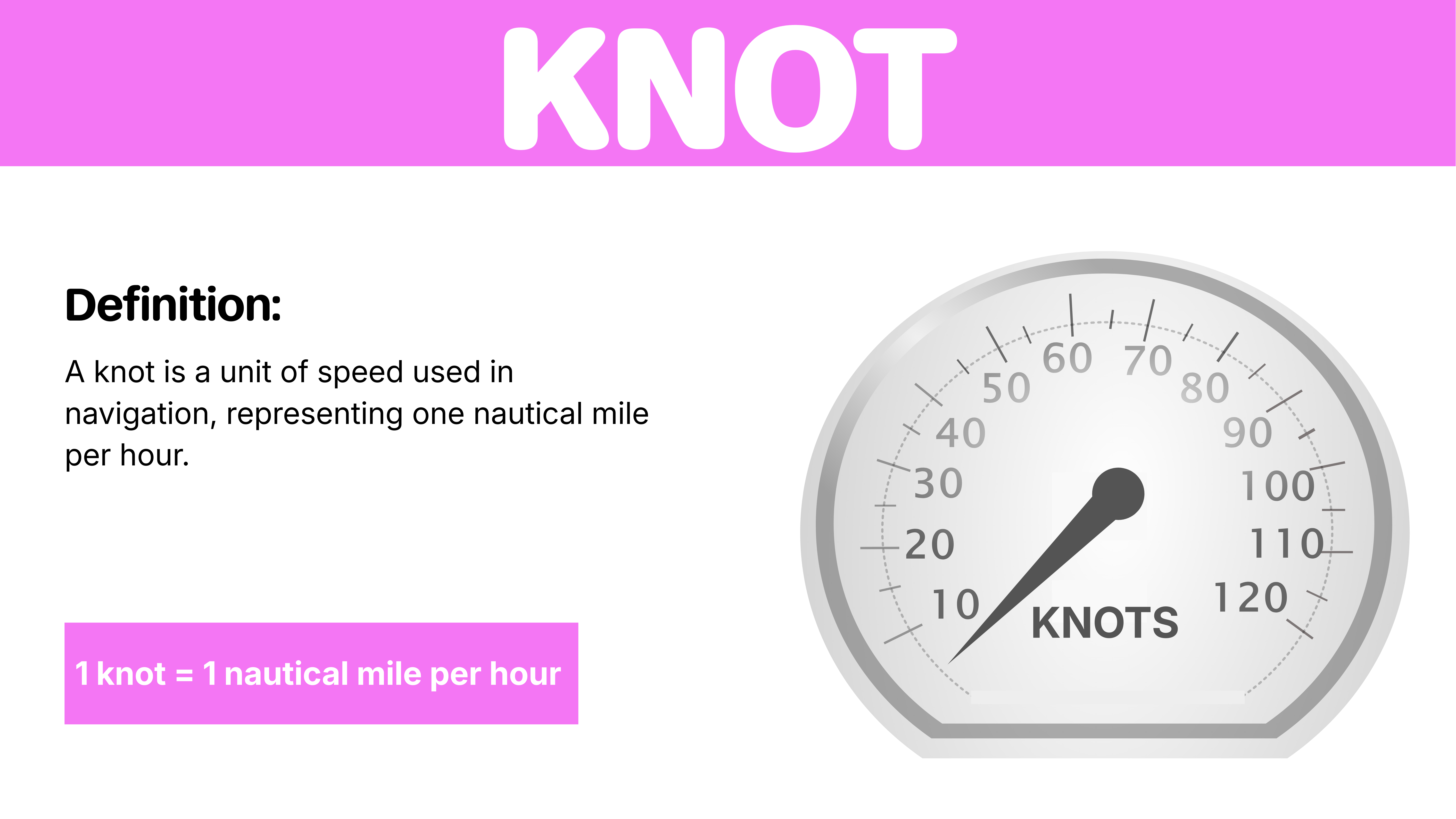
A knot is a measure of speed used at sea and in aviation.
One knot equals one nautical mile per hour.
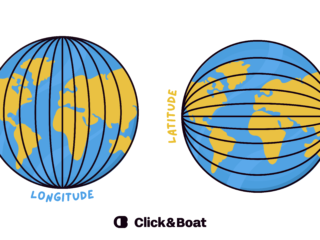
A nautical mile is based on the Earth’s shape. It matches one minute of latitude on a chart. That makes it very handy for navigation. If your boat sails at 6 knots for one hour, you travel about 6 nautical miles.
So when a skipper says “We cruise at 7 knots,” they simply mean the boat covers seven nautical miles in one hour.
N.B. Don’t confuse knot speed with the rope knots you tie on board like the essential sailing knots every boater should know, such as the bowline or clove hitch.
Where does knot speed come from?
The word knot comes from an old way of measuring speed. Sailors used a log line.
They threw a piece of wood, the “log”, over the stern. This log was tied to a long rope with knots tied at equal spacing. A sailor let the rope run free for a set time, often measured with a sandglass. They then counted how many knots passed through their hands.
The number of knots that slipped out gave the ship’s speed. The method has changed, but the unit stayed. That is why we still talk about knot speed today.
Knots vs mph and km/h: how fast is a knot?
On land, we use miles per hour (mph) or kilometres per hour (km/h). At sea, knots fit better with nautical miles and charts.
Rough conversions:
- 1 knot ≈ 1.15 mph
- 1 knot ≈ 1.85 km/h
Here is a quick comparison:
| Speed (knots) | Approx. mph | Approx. km/h |
|---|---|---|
| 1 knot | 1.15 | 1.85 km/h |
| 5 knots | 5.75 mph | 9.26 km/h |
| 10 knots | 11.5 mph | 18.5 km/h |
| 20 knots | 23 mph | 37 km/h |
| 50 knots | 57.5 mph | 92.6 km/h |
| 100 knots | 115 mph | 185,2 km/h |
So a cruising sailboat at 6–7 knots moves about as fast as a bicycle in the city. A fast motorboat at 25 knots is closer to highway speed.
How is boat speed measured in knots?
Today, skippers no longer throw logs overboard. Most boats use a mix of instruments:
- A speed log or paddle wheel under the hull measures speed through the water.
- A GPS or chartplotter shows speed over ground. It uses satellites, so it includes the effect of currents.
- Some boaters also use navigation apps on a phone or tablet. These read the GPS chip and display knots.
Both values matter. Speed through the water helps trim sails and set engine power. Speed over ground is key for travel time and fuel planning.
Why knots matter for sailors and cruisers
Using knots keeps every part of navigation in the same language. Distances on charts use nautical miles. Wind forecasts use knots. Boat instruments show knots too.
This makes planning much easier. If the forecast says 15 to 20 knots of wind, a sailor knows what sails to set. If the route is 30 nautical miles and the boat averages 6 knots, the trip should take about five hours. Understanding knot speed helps you read weather reports, talk with charter companies, and plan safe passages. Once you get used to it, knots become as natural as mph on the road.
If you’re planning your next trip, you’ll often see cruising speed expressed in knots when you rent a boat, it helps you estimate how long it will take to reach each stop on your route.
Frequently Asked Questions
What is a knot in simple terms?
A knot is a unit of speed equal to one nautical mile per hour. It’s the standard way to express speed at sea and in the air.
How fast is 1 knot in km/h and mph?
1 knot ≈ 1.85/h (1.852 exactly) ≈ 1.15 mph.
Why do boats and planes use knots instead of km/h or mph?
Knots are based on the nautical mile, which is tied to the Earth’s latitude and longitude. This makes it much easier to read charts, calculate distances and plan routes in navigation.
Is a knot the same thing as a nautical mile?
Not exactly. A nautical mile is a distance (about 1.852 km), while a knot is a speed (nautical miles per hour). Saying “15 knots” is like saying “15 nautical miles per hour”.
How can I quickly convert
For a quick estimate:
- knots → km/h: multiply by 2 (15kn ≈ 30 km/h).
- knots → mph: add 15% (20kn ≈ 23 mph).
For more precision, use 1kn = 1.852 km/h = 1.1508 mph.